Type “best llm seo tracking tool” into Google right now and you’ll get a wall of listicles that all read the same: ten logos, three bullet points each, a CTA at the bottom. What you won’t find as often is someone actually explaining what these tools measure, why a US-based business should care about location in their prompts, or what a realistic before-and-after looks like once you start optimizing for it.
That’s the gap this guide tries to close. It pulls from current tool documentation, agency reviews, and the actual questions people are asking in places like r/localseo and r/SEO, then lays out what “LLM SEO optimization software” really covers, how the category is priced and structured in 2026, and what a sensible rollout looks like for a US company trying to show up in ChatGPT, Claude, Gemini, and Perplexity — not just Google.
What LLM SEO optimization software actually does
Strip away the marketing language, and tools in this space do three distinct jobs:
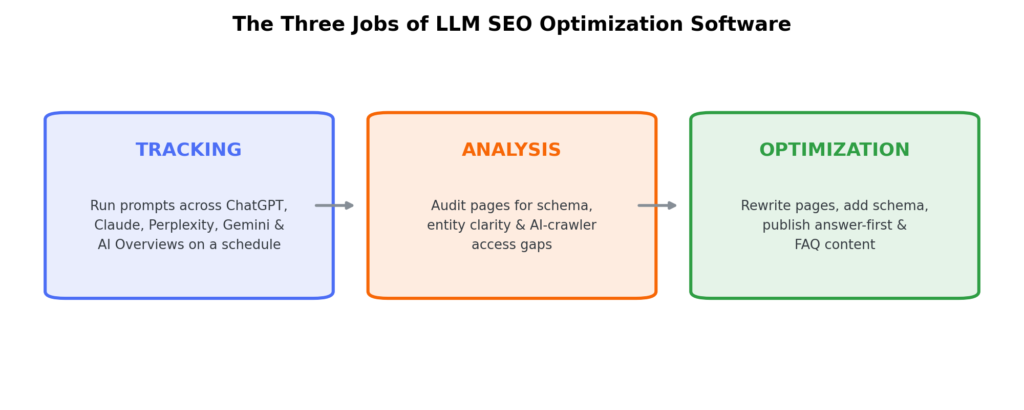
1. Tracking — running a set of prompts against ChatGPT, Perplexity, Gemini, Claude, and Google’s AI Overviews on a schedule, then logging whether your brand shows up, how often, and in what position relative to competitors. This is the “rank tracker,” except there’s no results page to snapshot — just synthesized text that can change from one run to the next.
2. Analysis — auditing your existing pages for the things AI systems tend to lift into answers: clear entity definitions, structured data, answer-first paragraphs, and FAQ-style content. Several tools flag when a page has no Organization or Product schema, or when AI crawlers (GPTBot, CCBot) are being blocked without anyone realizing it.
3. Optimization — the follow-through: rewriting pages, adding schema, and publishing new content aimed at the gaps the tracking and analysis stages uncovered.
Most vendors blend all three into one dashboard, but it’s worth knowing which job you actually need solved before you buy anything.
Why this matters more in 2026 than it did a year ago
A few data points explain the urgency. Cloudflare has reported that GPTBot crawl traffic has grown sharply year over year, which tells you AI systems are pulling from more of the open web than ever. At the same time, independent trackers have found that a large share of AI citations — some analyses put it above 70% — link to a source domain without ever naming the brand in the visible answer text. In other words, an LLM can pull your data and give you zero credit for it unless your content and entity signals make that harder to avoid.
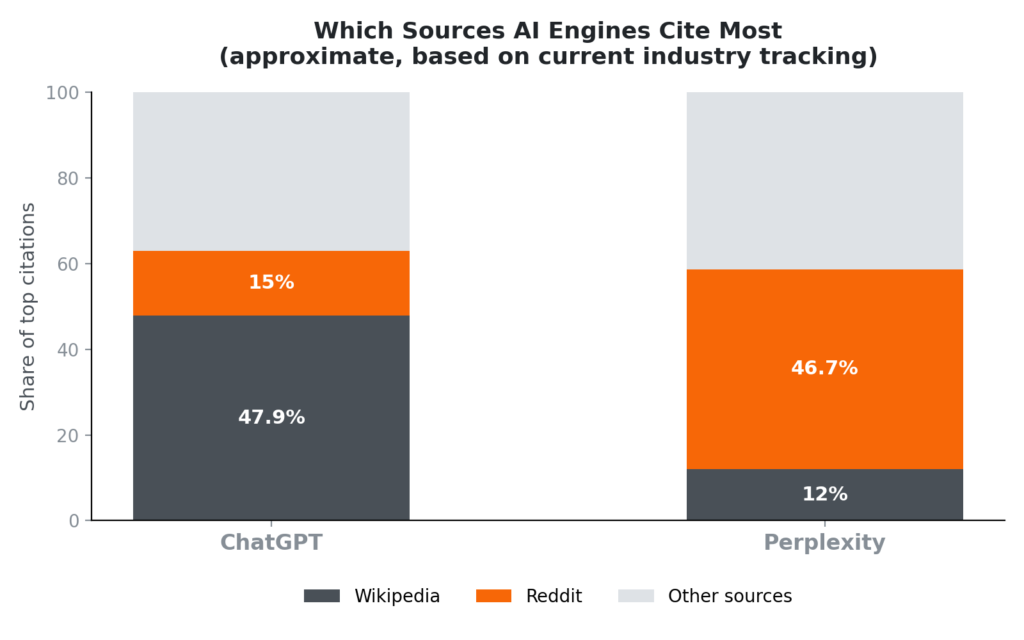
Citation behavior also differs by engine. Research circulating among AI-visibility vendors this year has found that ChatGPT leans heavily on Wikipedia as a citation source, while Perplexity favors Reddit threads more than any other single domain. That split matters practically: a strategy built only around traditional link building or only around one platform’s quirks will leave real gaps on the others.
What people are actually asking (Reddit, Quora, and community threads)
Pull back from vendor content and look at where actual practitioners are asking questions — r/localseo, r/SEO, r/DigitalMarketing — and a few recurring themes show up:
- “Is there a rank tracker for AI results?” — People are looking for something that behaves like a familiar SERP tracker but for ChatGPT and Perplexity, and are often surprised that “rank” doesn’t mean the same thing when there’s no ordered results page.
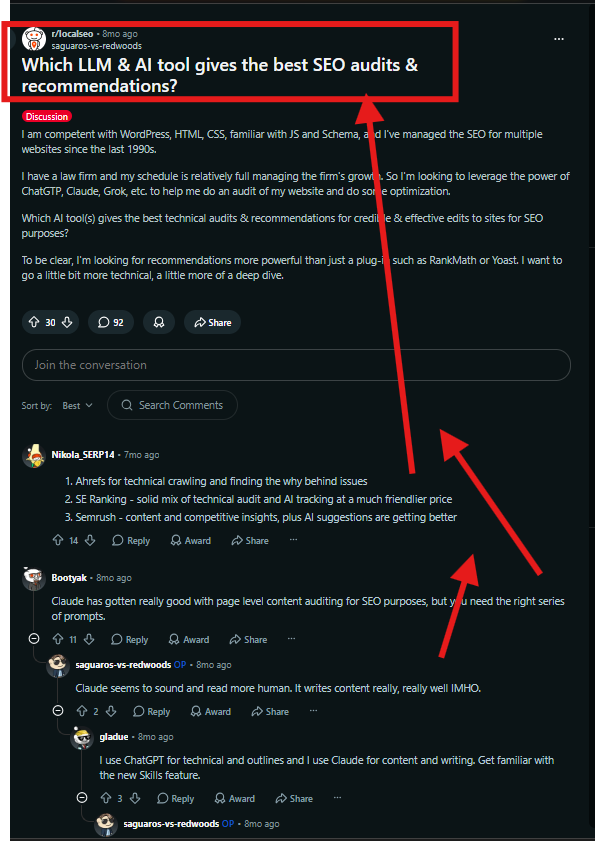
- “Which LLM AI tool gives the best SEO audits?” — This comes up constantly in local SEO communities, usually from agency owners trying to figure out whether to add an AI-visibility line item to existing client reports.
- “How do I see when ChatGPT changes its answer?” — A recurring frustration is that AI answers are non-deterministic; ask the same prompt twice and the phrasing, sources, or even brand mentions can shift. This is why serious tools now run each prompt multiple times and track the pattern, not a single snapshot.
- Local SEOs specifically want tools that support US-focused and location-based prompts — “best LLM SEO optimization software near me,” or prompts specifying a city or state — because AI engines are still much less precise about geography than Google Maps or local pack results.
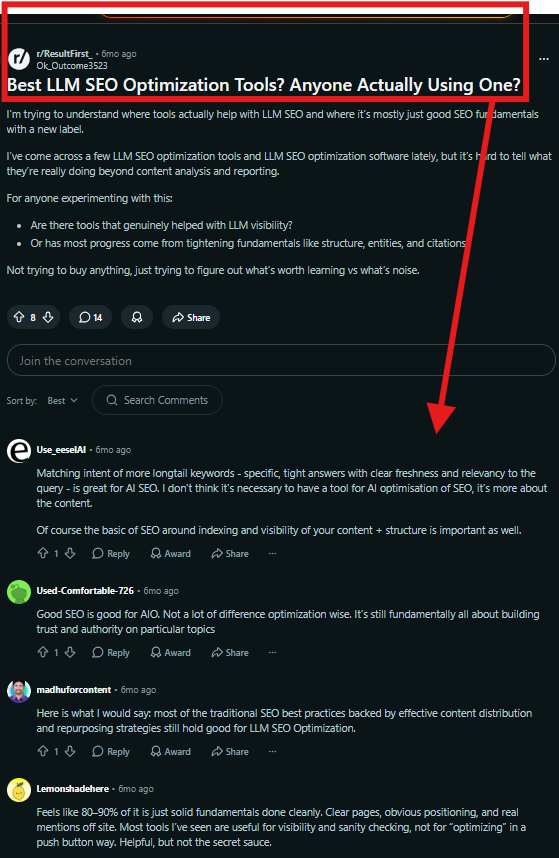
A consistent, if less flattering, pattern also shows up in these threads: people openly discussing “seeding” brand mentions into Reddit because Reddit is such a heavily cited source for Perplexity and other engines. Some vendors even sell this as a managed service, posting from aged accounts to make it look organic. Worth flagging directly — using accounts to fake organic community endorsement is a disclosure and platform-policy risk, not a shortcut, and it’s a different activity from genuinely answering questions in communities where you have real expertise.
The three types of LLM SEO tools, and where the market actually sits in 2026
AI visibility / tracking dashboards — Purpose-built platforms whose entire job is prompt-based monitoring across multiple engines. Names that recur in 2026 comparisons include Profound, AIclicks, Peec AI, Rank Prompt, Morningscore, Omnia, and Topify. Pricing in this tier typically starts at $59–$99/month for a small prompt allowance (30–50 prompts) and scales to $400–$500+/month for agency or enterprise use with more prompts and multi-model coverage.
All-in-one SEO platforms with an AI module bolted on — Semrush’s newer “Semrush One” tier added an AI Visibility Toolkit that tracks a large volume of prompts across ChatGPT, Google AI Mode, Perplexity, and AI Overviews across several English-speaking and European markets, priced from roughly $165/month. Ahrefs added “Brand Radar” as an add-on rather than a core feature — useful data, but priced separately per platform tracked, which pushes the effective cost well above what a standalone AI-visibility tool charges. SE Ranking folded in an “AI Rankings Report” at a more moderate price point. Surfer SEO ships an “AI Tracker” alongside its existing Content Editor.
Analysis/optimization tools — Tools like Rankability and Frase focus more on making content structurally easier for AI systems to lift (headings, answer-first paragraphs, FAQ blocks) than on tracking citations directly, though several are adding basic AI-visibility features as a secondary layer.
The practical takeaway from current buyer’s guides: nobody is claiming one platform does everything well. Agencies commonly pair a tracking-focused tool with their existing SEO stack rather than replacing it.
A realistic case study: what improvement can look like
A quick note before this section: the numbers below are an illustrative, hypothetical model — not results from a real, named company. They’re built from the ranges that current vendor case studies and industry reports commonly report, so you can see what a plausible before-and-after looks like and use it as a benchmark, not as a guarantee.
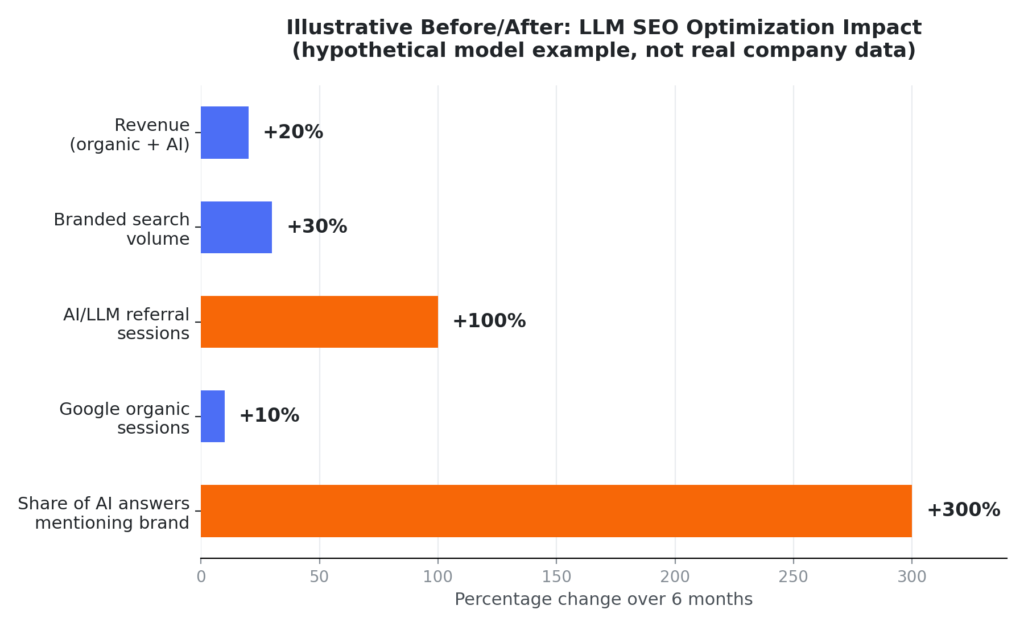
Scenario: A US-based B2B SaaS company sells software in a competitive niche. It has solid traditional SEO — decent titles, some backlinks, a working blog — but no AI-visibility tracking and thin structured data.
Baseline (Month 0):
- Google organic sessions: ~10,000/month
- AI/LLM referral sessions: ~200/month
- Branded searches: ~1,000/month
- Share of monitored AI answers mentioning the brand: 5%
What changed over 6 months:
- Connected a prompt-tracking tool covering ChatGPT, Claude, Perplexity, Gemini, and AI Overviews for a set of “best LLM analyzing software” and location-qualified prompts.
- Audited key pages and found missing Organization/Product schema, FAQs that existed in plain text but weren’t marked up, and long marketing copy with few clearly extractable facts.
- Added JSON-LD schema, restructured pages into answer-first sections with headings like “What is Best LLM SEO software?” and “Pricing and plans,” and published FAQ content mirroring real questions people ask in communities like Reddit.
A plausible outcome range, based on patterns reported across current case studies:
- Share of monitored AI answers mentioning the brand: 5% → 20–25%
- Google organic sessions: modest single-digit-to-low-double-digit percentage growth
- AI/LLM referral sessions: often doubling or more, since referral volume typically starts from a very small base
- Branded search volume: a moderate increase, as more people encounter the brand in an AI answer and then search the name directly
- Revenue attributed to organic + AI channels: a moderate lift, generally smaller in percentage terms than the visibility gain, since AI referral traffic is a small share of total sessions even after it doubles
The general shape — AI visibility moving faster and further than raw traffic, and traffic moving faster than revenue — is consistent with what several vendors and agencies have published this year. Treat any specific percentage a vendor shows you as a best-case example unless they can show you the underlying account.
How to choose the right tool
- Engine coverage. ChatGPT, Perplexity, Gemini, and Google AI Overviews are treated as the baseline set in 2026; a few platforms now add Grok and the Claude model family too. A tool that only watches one engine is not tracking AI search anymore, just one product.
- Location support. For US businesses, check whether the tool actually lets you run city- or state-qualified prompts, not just generic ones. Most engines are still far less location-precise than Google Maps, so ask the vendor to show you an example before buying.
- Citation-level detail, not just mention counts. A tool that tells you which URLs and domains an engine cites — not just whether your brand name appeared — is what lets you act on the data.
- Multi-sampling. Because AI answers vary run to run, look for tools that query the same prompt multiple times and report a pattern rather than a single snapshot.
- Integration with what you already use. Does it connect to GSC and GA4 so you can tie AI-referral traffic back to real sessions? Most buyers regret adding a fully siloed tool.
- Reporting you can hand to a client or a boss. White-label PDF/HTML reports and clean dashboards matter more once you’re past the “just checking this out” stage.
FAQs
What is LLM SEO optimization software? It’s software that tracks whether your brand appears in AI-generated answers (ChatGPT, Claude, Perplexity, Gemini, Google AI Overviews), analyzes your content and structured data for AI-readability, and helps you optimize pages so language models can confidently cite you.
Which LLM SEO tracking tool is best for a US-based business? There isn’t one universal answer — it depends on scale. Solo operators and small teams often start with a lower-cost, prompt-tracking specialist (in the roughly $60–$150/month range); agencies and larger SaaS teams tend to lean on an all-in-one platform’s AI module so tracking sits next to their existing SEO data. Whichever you pick, confirm it supports US-location prompts specifically, since that’s a common gap.
How is LLM SEO different from regular SEO? Regular SEO optimizes for a ranked results page. LLM SEO (sometimes called GEO, for generative engine optimization) optimizes for being cited or paraphrased inside a synthesized answer where there’s no fixed ranking — visibility is measured by mention frequency, citation source, and share of voice instead of position 1–10.
Does LLM SEO improve Google rankings too? Often, indirectly. The structural work involved — clearer entities, better schema, answer-first content — tends to help traditional organic performance as well, though the two channels are tracked with different metrics and shouldn’t be conflated.
How do AI citations affect traffic and revenue? AI referral traffic is still a small slice of most sites’ total sessions, but it tends to convert at least as well as organic traffic because it often comes from high-intent, comparison-style prompts. The typical pattern reported across current case studies is that AI visibility improves fastest, referral traffic follows at a slower rate, and revenue impact is the most modest and gradual of the three.
Conclusion
The strongest LLM SEO content in 2026 doesn’t pretend the category is settled — it’s still being figured out in real time, by the same practitioners asking questions in Reddit threads that vendors are trying to answer in their blog posts.
Pairing genuine research (what tools actually measure, what they cost, what real forum questions reveal) with a clearly labeled, realistic example of what improvement looks like is what separates a useful guide from another recycled top-10 list. Whether you’re evaluating a dedicated AI-visibility tracker or an add-on inside a platform you already pay for, the fundamentals stay the same: track multiple engines, audit for structure and entities, fix what’s missing, and measure the follow-through in referral traffic and branded search — not just a rising mention percentage.
Sources
- PageOptimizer Pro — LLM SEO Comparison: Rankings & Analysis
- OneLittleWeb — 15 Best AI SEO Tools We’ve Tested for 2026
- AIclicks — Best LLM SEO Analysis Tools in 2026
- AIclicks — Best AI Search Monitoring Tools for ChatGPT
- Wellows — How to Rank Higher in ChatGPT (2026)
- Omnia — ChatGPT Rank Tracking Tool Buyer’s Guide
- SE Ranking (Visible) — Best ChatGPT Rank Tracking & Visibility Tools 2026
- Trackings.ai
- Morningscore — ChatGPT Rank Tracker
- Topify — AI Answer Optimization: 7 ChatGPT Rank Trackers Tested
- r/localseo — Which LLM AI tool gives the best SEO audits?
- r/localseo — I’m a lawyer with zero SEO knowledge, I built and…