The article written by M Usman Anwar, 5+ year experience in SEO also co-founder of Digital Marketing Agency.
I still remember the week an AI Overview quietly wiped out 40% of the click-through rate on one of my client’s best-performing blog posts. The page hadn’t dropped in rankings. It was still sitting at position 3. But Google had started answering the question directly at the top of the page, and people stopped scrolling down to click.
That was the moment I stopped treating AI Overviews as “just another SERP feature” and started treating them as the new front door to search. Since then I’ve audited dozens of sites, rebuilt content structures from scratch, and tracked which pages get quoted and which get skipped.
This article is everything I’ve learned — combined with what Google itself publishes, what independent studies from Ahrefs, Semrush, and SE Ranking have found, and what other practitioners are saying in places like Reddit and Quora right now.
If you run a business — whether it’s a local agency in New York or a SaaS company competing globally — this is the practical playbook for getting cited before your competitors do.
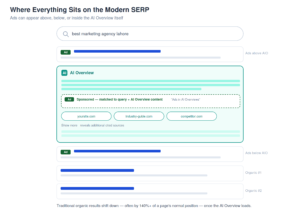
Ads can now appear above, below, or literally inside the AI Overview box — not just around it.
What AI Overviews Actually Are (And Why the Stakes Are Higher Than a Featured Snippet)
AI Overviews are Google’s AI-generated summaries that sit above the traditional blue links. Instead of pulling a single quoted excerpt from a page (the old featured snippet model), Google now synthesizes an answer from multiple sources and displays several citations at once.
Two things make this different from anything SEOs have dealt with before:
- It steals attention before anyone scrolls. Depending on which study you look at, AI Overviews now show up anywhere from roughly 15% to over 50% of search results, with the wide range reflecting differences in tracking methodology, query sets, and how fast the rollout has moved across markets.Whatever the exact number in your niche, the direction is the same: more of the page real estate above the fold now belongs to a synthesized answer, not a list of links.
- It sends “halo” authority to whoever gets cited. Being named as a source inside an AI Overview reads as an implicit endorsement. Users treat it almost like a stamp of trust, which is why the businesses that get cited consistently tend to see stronger brand recall and more qualified leads — even if raw click volume drops.
I’ve watched this play out on the revenue side too. HubSpot has talked publicly about a steep drop in organic traffic alongside continued revenue growth in the same period — a pattern several of my own clients have echoed.
Fewer visitors, but the ones who do click are further along and easier to convert. That’s the trade-off you’re optimizing for now: not raw traffic, but qualified visibility.
How Google Actually Chooses What to Cite
Google hasn’t published a precise ranking formula for AI Overviews, but between Google’s own documentation, third-party research (Ahrefs’ large-scale citation study is the one I go back to most), and my own testing across client accounts, the pattern is consistent.
1. You almost always have to be ranking already
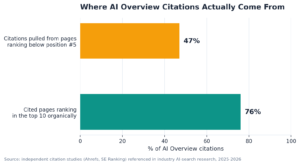
Research analyzing large samples of AI Overview citations found that roughly three-quarters of cited pages were already ranking in the top 10 organic results for that query. AI Overviews rarely reach past page one to “discover” a hidden gem — it draws primarily from content Google already trusts enough to rank.
That said, don’t assume top 10 guarantees a citation, or that a citation always comes from your best-ranking page. A meaningful share of citations — close to half in some datasets — come from pages ranking below position 5, often because Google’s system breaks your query into several sub-questions and pulls the best answer for each one from wherever it lives on your site, not necessarily your flagship page.
2. Google fans your query out into sub-questions
This is the part most business owners don’t realize. When someone searches “business casual wedding attire” Google doesn’t run one search — it runs a “query fan-out,” breaking that into parallel sub-queries: what should women wear, what should men wear, are ties required, what shoes work. Each sub-query pulls from whatever page best answers it, then Gemini synthesizes all of it into one response.
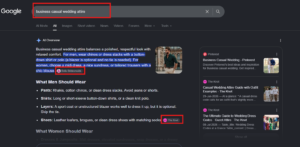
In practice, this means a supporting blog post buried three levels deep in your site structure can get cited even when your main service page doesn’t — provided that supporting post answers one specific sub-question clearly. When I ran this audit across a batch of client pages recently, the citations skewed toward FAQ sections and sub-topic pages far more often than the primary landing page itself.
That single insight changed how I brief content writers now: I ask them to treat every H2 as its own mini-answer that could stand alone if quoted out of context.
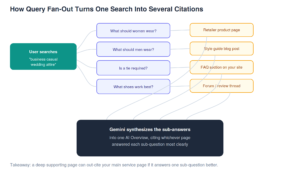
This is why a deep supporting page sometimes gets cited when your homepage doesn’t — it won the sub-question, not the headline query.
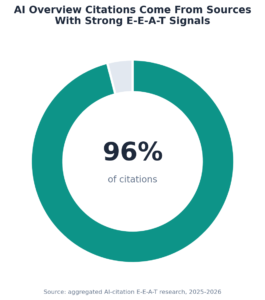
3. E-E-A-T is the gatekeeper, not a bonus
Google is making a risk decision every time it cites you. If it quotes bad information, that reflects poorly on Google, not just on you. So the system defaults toward sources it can trust — and trust, per Google’s own Search Quality Rater Guidelines, is described as the most important piece of E-E-A-T, because a page can look experienced and expert and still get passed over if it isn’t trustworthy.
In content I’ve reworked, the single highest-leverage change has consistently been adding named author bios with real credentials and visible publish/update dates — not because it’s a magic trick, but because it removes the single biggest reason Google’s AI has to hesitate.
Quick reference: the levers that matter most
| Factor | What it means in practice | Why AI Overviews care |
|---|---|---|
| Organic ranking | Be in the top 10-20 for the query | AI cites almost exclusively from pages already earning trust |
| Semantic completeness | One page fully answers the main question plus its sub-questions | Fewer, more complete sources are easier to cite confidently |
| Answer islands | Self-contained paragraphs of roughly 40-170 words | Easy to lift and quote without losing context |
| E-E-A-T | Named authors, real credentials, transparent sourcing | Reduces the risk Google takes by citing you |
| Schema markup | FAQPage, HowTo, Article, Organization, LocalBusiness | Helps AI parse meaning, not just text |
| Brand/entity signals | Consistent name, sameAs links, reviews, mentions | Confirms you’re a stable, real entity worth trusting |
Building Pages That AI Actually Wants to Quote
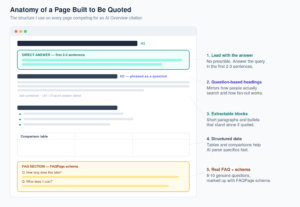
Once you know what Google is looking for, the content work becomes mechanical. Here’s the structure I now use on every page I want to compete for an AI Overview citation.
Lead with the direct answer, not the throat-clearing
Open with two to three sentences that answer the core question outright — no “in today’s fast-changing digital landscape” preamble. Google’s systems are scanning for a quotable passage near the top of the page; if the real answer doesn’t show up until paragraph six, you’ve likely already lost the citation to a competitor who put it in paragraph one.
Turn every H2 into a question
Instead of “AI Overview Ranking Factors,” write “What Ranking Factors Does Google Use for AI Overviews?” This does two things: it mirrors how people actually phrase queries (and how Google’s fan-out sub-queries get generated), and it forces you to open that section with a direct answer rather than a vague topic sentence.
Keep answer blocks short and self-contained
Several independent analyses converge on a sweet spot of roughly 130-170 words per answer block — enough to be genuinely useful, short enough to be lifted cleanly. Every section should be able to stand alone if someone quoted just that paragraph out of context. If a reader would be confused reading only that block, it needs tightening.
Add a genuine FAQ section
Eight to ten real questions, phrased the way customers actually ask them, each with a direct, concise answer (aim for 50-150 words). Mark it up with FAQPage schema. Google restricted the visual rich-result display of FAQ schema for most sites in 2023-2025, limiting it mostly to government and health sources — but the schema still helps AI systems parse and extract your Q&A content, even without the rich snippet showing up in traditional results.
Be specific, not vague
This is the difference between content that gets cited and content that gets skipped:
- Vague (skipped): “This approach helps a lot and improves results significantly.”
- Specific (cited): “This approach cut page load time by 40%, which improved our Core Web Vitals score and lifted mobile conversions.”
AI systems favor precision because precision is quotable. Vague claims can’t be extracted as a clean answer.
Use multiple formats, not just text
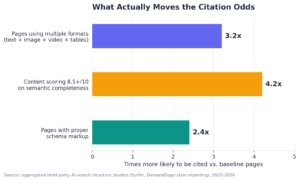
Pages that combine text, images, structured tables, and video consistently outperform text-only pages in citation studies I’ve reviewed, with some research showing multi-format pages earning well over double the citation rate of plain-text equivalents. If you’re publishing a how-to, add a short supporting video and upload it to YouTube specifically — AI Overviews have shown a growing tendency to cite YouTube directly alongside written sources.
E-E-A-T, in Practice, Not Just in Theory
E-E-A-T gets thrown around as a buzzword, so let me break down what I actually implement for clients, one letter at a time.
Experience — Show you’ve actually done the thing. Case studies, screenshots from real projects, specific numbers from your own work (“in one New York-based client account I managed this quarter…”), not just secondhand research repackaged as advice.
Expertise — Author bios with real, checkable credentials. If you’re writing about a YMYL topic (health, finance, legal, safety), this becomes non-negotiable — Google holds those pages to a noticeably higher bar.
Authoritativeness — This is earned outside your own site: backlinks from credible publications, brand mentions in industry press, a presence in Google’s Knowledge Graph.
Research correlating brand web mentions with AI Overview citation rates has found that brands in the top quartile for mentions earn dramatically more citations than those just below them — sometimes by an order of magnitude. If nobody else is talking about you, the AI has no external confirmation that you’re worth citing.
Trustworthiness — HTTPS, transparent authorship, real contact information, a visible privacy policy, and content that gets updated rather than left to rot. Google’s own quality rater guidance is explicit that trust outweighs the other three factors when they conflict — an untrustworthy page doesn’t get cited no matter how expert it sounds.
The Technical Checklist Your Site Has to Pass First
None of the content work matters if Google can’t crawl, index, and confidently render your page. Before I touch a single word of copy on a client site, I run through this:
- Indexing — Confirm the page is indexed and eligible to show a snippet in regular search (check via URL Inspection in Search Console).”No noindex, no nosnippet, no—” cuts off and runs straight into the next heading, “Winning the Paid Side: Google Ads Inside AI Overviews.”This is the part most content-focused guides skip, and it’s directly relevant if you’re running paid alongside organic. Google’s own documentation on ads and AI Overviews lays out exactly how this works, and it’s worth understanding precisely because most advertisers are getting it wrong. A few things Google states plainly:
- You cannot target ad placement inside AI Overviews directly. Ads that appear there come from your existing Search, Shopping, and Performance Max campaigns winning the normal auction and matching both the user’s query and the content of the AI Overview itself.
- Ads inside AI Overviews (not just above/below them) are currently live in English, on mobile and desktop, in a specific set of markets — which includes Qatar, alongside the US, Canada, Australia, India, and several others. If you’re advertising to a USA audience in English, this already applies to your account.
- Google explicitly recommends broad match plus Smart Bidding, or fully keywordless targeting through Performance Max, Dynamic Search Ads, or AI Max for Search — because AI Overview queries are often long, conversational, and impossible to predict with a fixed keyword list.
- Ads won’t show inside AI Overviews for sensitive categories: adult content, alcohol, gambling, finance, healthcare, politics, and similar verticals.
The mental model I use with clients: the AI Overview explains the problem, and your ad is the practical next step. If your landing page mirrors the structure of the overview itself — answering the same underlying question with a clear next action — you’re far more likely to be judged “relevant enough” to serve as that next step.
Building Topical Authority: One Page Is Never Enough
A single excellent page rarely wins consistent citations on its own. What I’ve seen work repeatedly is a hub-and-spoke content cluster: one pillar page covering a topic broadly, and 8-15 supporting pages that each go deep on a specific sub-question, all cross-linked with descriptive anchor text.
This matters more for AI Overviews than it did for traditional SEO because of that query fan-out behavior described earlier — Google is running multiple sub-queries per search and pulling the best answer for each.
A site that only has one page on a topic can win one citation at most. A site with a genuine cluster can win several citations across a single search session, compounding its visibility.
Off-Site Signals: Why Brand Mentions and Real Social Chatter Matter as Much as Your Website
This is the piece most businesses miss entirely, and it’s become one of the biggest parts of my own process over the last year. Google’s AI — and every other LLM-based search tool, for that matter — doesn’t just crawl your website. It cross-references what independent voices elsewhere are saying about you before deciding how much to trust your own claims.
Think about it from the model’s side. If your homepage says “we’re USA most trusted digital agency,” that’s one source, and it’s a source with an obvious incentive to say exactly that.
But if a Reddit thread, a handful of X posts, a Facebook group discussion, and a Google review all independently say the same thing without prompting from you, that’s corroboration. Corroborated claims are what a risk-averse system leans on when it has to decide who to cite.
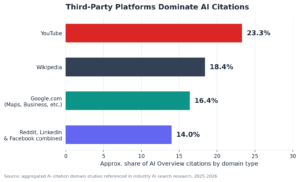
A few things I’ve confirmed through my own tracking and through the wider research on this:
- Unlinked brand mentions now function almost like backlinks.
You don’t need someone to hyperlink to you for it to count. A forum comment that names your business by name, in a positive context, next to a real discussion of the problem you solve, is a signal in its own right.Research correlating brand mention volume with AI citation rates has found that businesses in the top quartile for web mentions earn dramatically more AI citations than those just outside it — in some datasets, the gap runs close to 10x. - Reddit specifically has become a major citation source almost overnight.
It went from a minor player to one of the most frequently cited domains in AI Overviews in a very short window, and it now shows up in a large majority of AI Overview results across broad query sets.If there’s an active subreddit for your industry or city, silence there is a missed opportunity — not because you should post promotional content, but because genuine participation is exactly the kind of independent, first-person signal these systems are built to surface. - First-person “I used this and here’s what happened” posts carry outsized weight.
A tweet on X, a Facebook post in a local community group, or a detailed forum reply describing an actual experience reads as the “Experience” component of E-E-A-T — but coming from someone other than you, which makes it more credible than anything you could write about yourself.When I’ve traced citation wins back to their source for client accounts, a surprising number trace back to exactly this kind of organic, unprompted mention rather than owned content. - “Best of” and recommendation threads are worth actively watching.
Searches like “best marketing agency in New York” or “who do you use for X” generate exactly the kind of long-tail, conversational query that triggers both an AI Overview and query fan-out. If your brand comes up genuinely in those threads — on Reddit, in a Facebook group, in a Quora answer, even in a WhatsApp-adjacent public forum that gets indexed — you’re feeding the exact kind of third-party validation the system is trying to find.
Here’s what I actually do with clients on this front, in order of effort-to-impact:
- Set up brand monitoring. Google Alerts is free and a fine starting point; tools like Mention or Semrush’s brand tracking go deeper and catch social mentions Google Alerts misses. Know where you’re already being talked about before you try to expand it.
- Make it easy for real customers to talk about you where it counts. After a good project or sale, ask directly for a Google review, and don’t be shy about mentioning that a mention on X or in a relevant Facebook group helps other people find you too. This only works if the experience was genuinely good — asking unhappy customers to post publicly backfires fast.
- Show up in your own industry’s forums and subreddits as a real person, not a brand account. Answer questions helpfully, mention your business only when it’s actually relevant to the answer, and expect to spend months building credibility before it pays off.Communities can tell the difference between genuine participation and drive-by self-promotion, and so, increasingly, can the AI systems trained on how those communities react.
- Engage with mentions you find, positive or negative. A business that visibly responds to a Facebook comment or a Reddit reply signals active, trustworthy management — silence on a public complaint is itself a trust signal, just a bad one.
- Never manufacture this artificially. Paid fake reviews, sockpuppet forum accounts, and bought “engagement” are increasingly detectable by both platform moderation and by the AI systems evaluating trust signals, and getting caught costs you more credibility than you’d ever gain. This is the one shortcut in this entire article I’d actively tell you not to take.
The honest summary: your website structure gets you eligible to be cited. What other people say about you, unprompted, on platforms you don’t control, is often what tips the decision in your favor.
Tracking Whether It’s Working
You can’t manage what you don’t measure, and AI Overview visibility isn’t reported cleanly anywhere yet.
Manual testing (free, and where I start every audit):
Open Chrome in incognito mode, search your 20-30 target queries weekly, and log whether an AI Overview appears, whether you’re cited, and who is cited instead of you. It’s tedious, but it’s the ground truth, and personalization-free incognito results are the closest thing to what a stranger actually sees.Google Search Console:
Search Console doesn’t separate AI Overview clicks from regular organic clicks — a known limitation people raise constantly in the SEO community. But there’s a workaround: because every element on a results page (including an AI Overview) reports as a single “position,” a URL sitting at position 1 for an informational query with no featured snippet is a reasonable proxy signal worth investigating further.Third-party tools:
Several platforms now track citation frequency and share-of-voice across AI Overviews, ChatGPT, and Perplexity simultaneously. If you’re running client reporting, this is quickly becoming a standard line item — if your agency isn’t tracking it yet, it’s a fair question to ask them.The Mistakes I See Most Often
- Burying the answer. If your real answer shows up after 400 words of preamble, Google’s system will often find a competitor’s cleaner answer first.
- Over-optimizing into thin content. Stripping a page down to a bare snippet to “win the box” tends to backfire — it hurts engagement and loses you the long-tail rankings that got you eligible in the first place. AI Overviews still favor genuinely comprehensive pages; the trick is organizing that depth well, not deleting it.
- Letting content go stale. AI systems visibly favor freshness. A page that hasn’t been touched in two years, even if it once ranked well, tends to lose ground to a more recently updated competitor covering the same question.
- Faking authority. Purchased reviews, inflated credentials, and manufactured testimonials are increasingly detectable, and Google’s updated rater guidance specifically calls out deceptive trust signals. It’s not worth the risk.
A 30-60 Day Plan You Can Actually Run
This is close to the exact sequence I use with new clients:
Weeks 1-2 — Find the opportunity.
Export your top-20 ranking keywords, check which already trigger an AI Overview (most rank-tracking tools have a filter for this now), and shortlist 5-10 high-intent “money” queries plus 10 supporting informational queries.Weeks 2-4 — Rebuild the priority pages.
Rewrite intros to answer the query in the first two to three sentences. Convert H2s into questions. Add an 8-10 question FAQ section with schema. Add or fix Article/Organization/LocalBusiness schema. Add real author bios and case-study proof.Weeks 3-6 — Align paid media.
Turn on broad match and Smart Bidding for the same query themes in Search and Performance Max. Rebuild landing pages using the same answer-first structure. Clean up your Google Business Profile — categories, Q&A, regular posts.Ongoing — Monitor weekly.
Manually check your target queries, log who’s cited, and compare their structure against yours. This is genuinely a moving target; a citation you win this month isn’t guaranteed to hold next month.Frequently Asked Questions
How long does it take to start showing up in AI Overviews?
In my experience, technical fixes (schema, indexing, crawlability) can show effects within a few weeks. Content restructuring and E-E-A-T building take longer to compound — plan on 60-90 days before you have enough signal to judge whether a strategy is working, and treat anything faster as a bonus, not the baseline.Do I need to abandon traditional SEO to focus on AI Overviews?
No — and this is worth saying clearly. AI Overview citations draw overwhelmingly from pages that are already ranking well organically. Traditional SEO fundamentals (indexing, backlinks, helpful content, page experience) remain the foundation. AI Overview optimization is additive structure and trust signals layered on top, not a replacement.Can I pay to guarantee a spot inside an AI Overview?
No. Google is explicit that you cannot directly target ad placement inside AI Overviews, and you cannot opt out of it either. Ads that appear there are won through the normal auction based on relevance to the query and the overview’s content.Does this work the same way for ChatGPT and Perplexity?
The underlying principles overlap heavily — clear structure, direct answers, credible sourcing, schema markup — but each platform sources and weights signals differently. Treat Google AI Overviews, ChatGPT, and Perplexity as related but distinct optimization targets, not one single task.
References
- support.google.com/google-ads/answer/16297775
- support.google.com/websearch/answer/14901683
- developers.google.com/search/blog
- data-mania.com
- seo.com/ai/ai-overviews
- teamwti.com
- quora.com
- support.google.com/business/thread/354645227
- reddit.com/r/digital_marketing
- reddit.com/r/seogrowth
- ahrefs.com/blog
- semrush.com/blog
- fool.com
- gartner.com/en/newsroom
- ahrefs.com/blog
- semrush.com/blog
All statistics are drawn from the sources above and reflect the ranges reported across multiple independent studies as of mid-2026; AI Overview behavior continues to evolve, so treat exact percentages as directional rather than fixed