Every marketing team in the U.S. is asking some version of the same question right now: is AI-written content helping our business or quietly hurting it? The honest answer is that the question itself is too simple. AI hasn’t made content universally better or worse it has changed the economics of producing content, and in doing so, it has raised the bar for what counts as genuinely valuable to a reader.
This isn’t a theoretical debate. It’s measurable. Small businesses in the U.S. now produce roughly 71% of their website content with at least some AI involvement, and industry-wide adoption has climbed from under 40% in 2023 to the mid-80% range for small teams by 2026, according to content-industry research compiled by First Page Sage. At the same time, Google continues to say plainly that content isn’t demoted for being AI-assisted.
It’s demoted for being unoriginal, thin, or built primarily to game rankings. Those two facts sit next to each other uneasily, and this article is about reconciling them with evidence rather than opinion.
What “AI-written content” actually means
Not all AI involvement in content is the same thing, and lumping it together is where most of the online debate goes wrong. There’s a meaningful difference between:
- AI-assisted content: a subject-matter expert uses AI to organize a transcript, propose an outline, tighten a rough draft, or speed up research, then reviews, corrects, and adds original insight before publishing.
- AI-generated, human-edited content: AI produces most of the first draft, and a person edits it for accuracy, tone, and added value before it goes live.
- Fully automated publishing : AI output goes live with little or no human review, often at high volume.
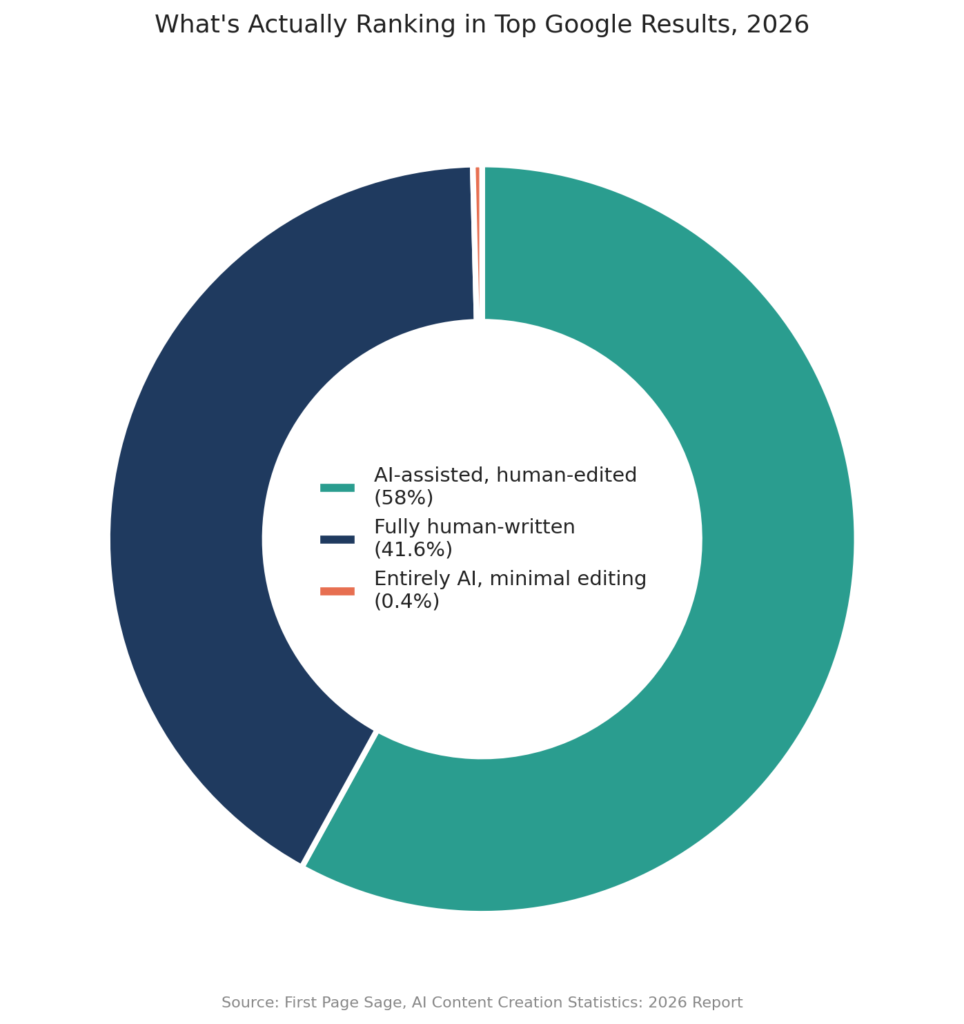
Industry data backs up why this distinction matters so much. Research from First Page Sage’s 2026 content report found that content published with minimal or no human editing made up under 0.5% of top-ranking Google results, while content that combined AI assistance with meaningful human editing accounted for the majority 58% of what actually ranks. Fully human-written content still holds a substantial 42% of top positions. Read together, these numbers point to one conclusion: it’s the editing, not the authorship label, that correlates with ranking success.
How much AI content is actually out there right now
The scale of adoption is worth understanding before debating its effects. Separate 2026 research paints a consistent picture:
- Small businesses use AI for content production at the highest rate of any business size (around 84%), with adoption falling as companies grow larger and add layers of editorial and legal review.
- The fully loaded cost of producing a standard article has dropped by roughly 70% across business sizes since AI tools became mainstream, according to First Page Sage’s cost analysis — though enterprises retain more of their pre-AI cost because compliance and brand review don’t compress the way drafting time does.
- On social platforms, AI-generated text is most common on text-heavy, professional platforms like LinkedIn, and least common on communities that actively police machine-written posts, such as Reddit.
- A 2026 industry survey by Elorites Content, covering more than 1,100 writers and agencies across the U.S., U.K., India, and other markets, found that 88% of respondents now use AI tools in their writing workflow in some capacity but also that 69% of the same respondents believe average content quality across the industry has declined since AI became mainstream.
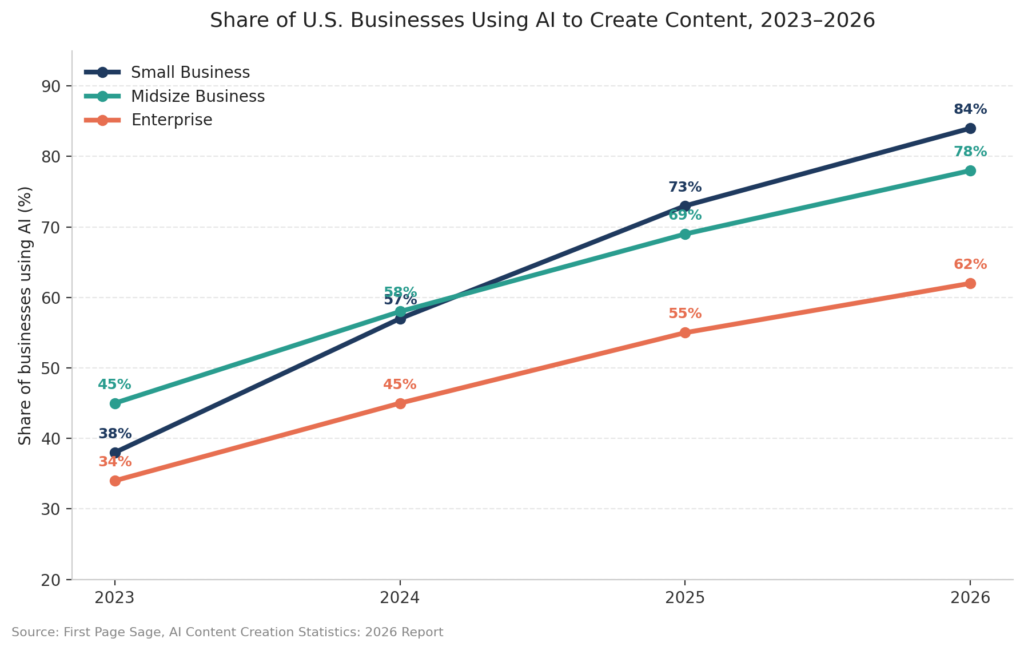
That last pairing near-universal adoption alongside a widely felt drop in quality — is the tension this whole topic revolves around. AI didn’t make good writing obsolete. It made mediocre writing nearly free to produce, which flooded the web with more of it.
The real productivity effect
The clearest, best-evidenced benefit of AI in content work is time savings not necessarily better ideas. A National Bureau of Economic Research field experiment covering 66 firms and more than 7,000 knowledge workers found that regular users of a generative AI tool cut roughly two to three-and-a-half hours of weekly email time and reduced work done outside normal hours. Critically, the same researchers found no meaningful shift in the total quantity or mix of tasks workers completed AI made existing work faster, but it didn’t automatically expand what people accomplished or improved judgment-based output.
That distinction matters for content teams specifically. Harvard Business Review’s 2026 research into real-world AI usage patterns has flagged a related risk it calls “thinkslop” — a growing worry that people are outsourcing not just the typing but the thinking behind their work, with much of the resulting business activity delivering marginal rather than transformative value so far.
For content specifically, the productivity paradox shows up in editing time. Elorites Content’s 2026 survey found that 63% of professional writers now spend more time editing AI output — fact-checking, correcting, and “humanizing” it — than they used to spend writing from scratch.
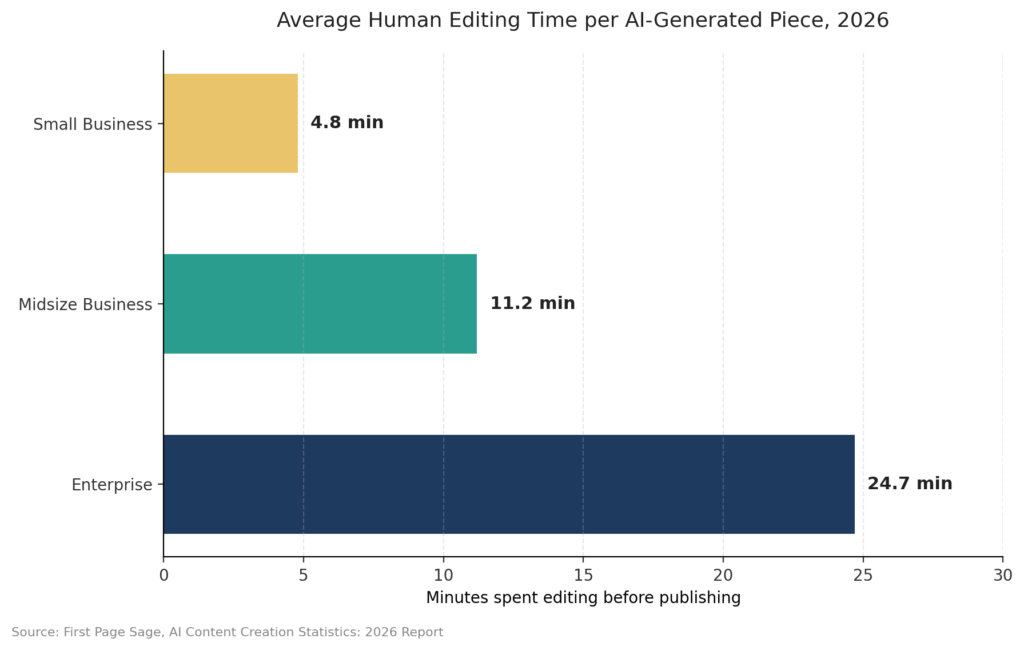
First Page Sage’s business research tells a similar story from the employer side: enterprise teams spend nearly 25 minutes editing a single AI-generated piece on average, more than five times longer than small businesses, largely because of compliance and brand-governance review. The saved time on drafting is real. But it doesn’t disappear — it often reappears downstream as verification work, and the businesses that skip that step are the ones producing the “generic AI content” readers increasingly notice and distrust.
Does AI-written content actually hurt SEO?
This is the question that drives most of the search traffic to this topic, and the evidence gives a fairly clear answer: no, not inherently — but scaled, low-value content does, regardless of who or what wrote it.
Google’s own spam policy documentation defines the relevant risk as scaled content abuse: generating many pages primarily to manipulate rankings, with little or no added value for users. The policy is explicitly method-neutral — it applies the same way whether the pages were written by a person, an AI tool, or produced by scraping and lightly rewriting someone else’s work. Google’s guidance for creators consistently emphasizes that generative AI can be a legitimate research and drafting aid, while warning that publishing large volumes of unoriginal or unhelpful pages, however they were produced, risks demotion or removal from search results.
In practice, that means the real danger was never “will an algorithm detect AI phrasing.” It’s whether a page adds anything a reader couldn’t already find elsewhere. A travel site that generates 500 near-identical city pages by swapping only the place name is a scaling strategy, not a content strategy — and it would have been penalized in 2015 for the same reason it’s penalized in 2026, regardless of the tool used to produce it.
The trust problem: how people actually react to detected AI content
Trust is where the data gets genuinely uncomfortable for marketers who assumed speed alone would win.
- First Page Sage’s 2026 survey of U.S. businesspeople found that a majority react negatively upon detecting AI-generated content sent to them, and about one in eight will refuse to continue the communication or transaction entirely. Individuals reacted even more harshly than businesspeople when AI use was detected in personal messages.
- Elorites Content’s industry survey found that 95% of clients now ask content providers for proof of human involvement, and 72% of firms said client onboarding has become harder because of AI-detection scrutiny on trial work — including cases where fully human-written content was incorrectly flagged as AI by unreliable detection tools.
- On the news and information side, Reuters Institute’s Digital News Report has found that while a meaningful share of people now use AI chatbots for news, trust in those AI-generated answers runs well below trust in news content generally — a gap of roughly 17 percentage points in recent research.
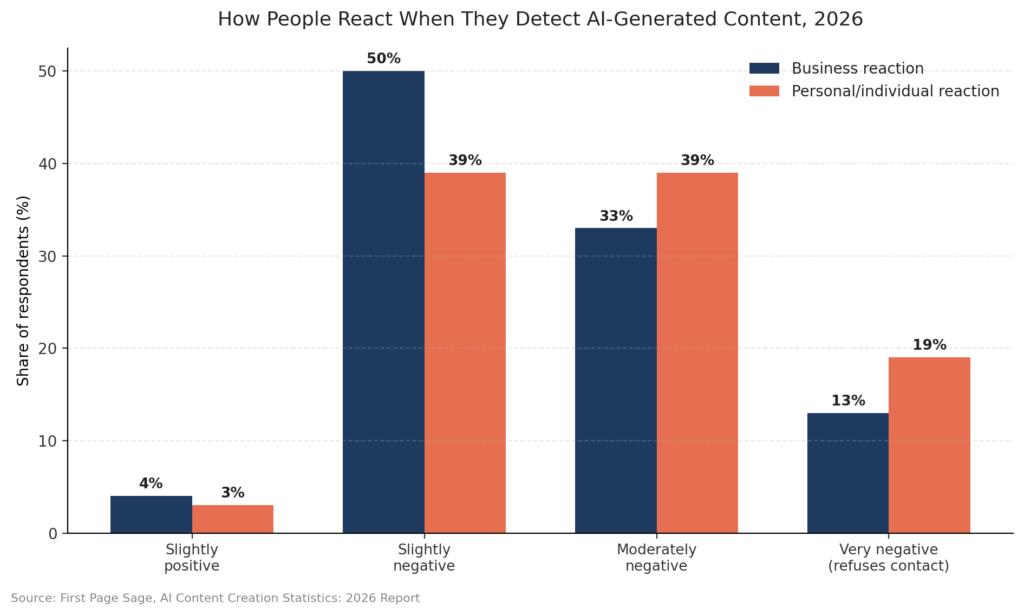
None of this means disclosure is legally or universally required for ordinary marketing content — it isn’t, in most contexts. But it does mean brands should assume a meaningful share of their audience is now actively looking for signs of unverified, unedited AI output, and reacting negatively when they find it. The businesses avoiding that reaction aren’t the ones hiding AI use; they’re the ones making sure nothing published under their name reads as generic or unverified in the first place.
The quality and hallucination problem
Speed without verification is where AI content goes wrong most often, and it isn’t a hypothetical risk. International policy research — including analysis from the OECD — has specifically flagged that generative AI systems can produce fluent, confident-sounding output that is factually incorrect, can reproduce or amplify existing biases, and can be misused to produce misleading content at a scale that was previously impractical for a small team to achieve.
This is precisely why AI output should be treated as an unverified draft rather than a source. Statistics, direct quotations, regulatory claims, medical or legal statements, and competitor comparisons all need to be checked against a primary source before publication — not because AI is unusually unreliable compared to a careless human writer, but because AI can produce incorrect information with the same fluent confidence as correct information, making errors harder to catch by tone alone.
The ownership and copyright question
There’s also a legal dimension that many content teams overlook. The U.S. Copyright Office has stated that AI-assisted work can receive copyright protection when a human author contributes sufficient expressive elements — through original human-written material, creative selection, or meaningful modification of AI output. Simply typing a prompt, without that added human authorship, is not enough to establish copyright over purely AI-generated material on its own.
The practical takeaway for a content library: don’t build your core assets entirely on unedited machine output. The more original reporting, analysis, editing judgment, and creative arrangement a business layers onto AI-assisted drafts, the more defensible — and more differentiated — that content becomes, both legally and competitively. Copyright rules vary by situation and jurisdiction, so specific disputes should go to a qualified attorney rather than a blog post.
Building E-E-A-T into AI-assisted content
Google’s Experience, Expertise, Authoritativeness, and Trustworthiness framework isn’t a checklist you bolt onto a finished article — it’s a description of what separates content a reader can actually rely on from content that merely sounds confident. For AI-assisted work specifically, the standards that matter most are:
- Experience — first-hand detail an AI model cannot invent: a mistake made and corrected, a project photo, a specific number from your own operation, a direct quote from someone who actually did the work.
- Expertise — content reviewed or authored by someone with a real, checkable claim to knowledge in the subject, not just fluent phrasing about it.
- Authoritativeness — a named, identifiable author or reviewer, a real organization behind the content, and a body of related work that demonstrates consistent depth in the topic.
- Trustworthiness — verifiable citations, transparent sourcing, visible correction processes, and accuracy on anything that touches money, health, safety, or legal decisions.
A useful test before publishing: could this specific paragraph have been written by anyone, about any business in this category, without changing a single fact? If yes, it’s a placeholder, not a finished piece — regardless of whether a human or a model typed it.
Writing for the topic, not the keyword: a semantic SEO approach
Search engines and AI answer engines alike no longer evaluate a page primarily by keyword density — they evaluate whether a page demonstrates real command of a topic, including the entities, subtopics, and questions a genuine expert would naturally address. That shift rewards a different kind of planning:
- Map the topic, not a single phrase. Before writing, list every sub-question a genuinely informed reader would have — not just the primary search term, but adjacent concerns, objections, and follow-up questions.
- Use natural entity relationships. Related concepts, tools, organizations, and terminology should appear where a real expert would mention them, not stuffed in for density.
- Answer the question directly, then support it. Structure sections so the direct answer comes first, followed by evidence, nuance, and exceptions — this format helps both human skimmers and AI systems summarizing your page.
- Cover the topic in enough depth to close the loop, so a reader doesn’t need to open five other tabs to get a complete answer — but don’t pad length for its own sake; unnecessary length can hurt as much as thinness.
The five distinctions worth defending in any content strategy
Pulling the research together, five distinctions separate content strategies that hold up from ones that eventually get penalized, distrusted, or both:
- AI-assisted is not the same as fully automated. An expert organizing their own knowledge with AI’s help is doing something fundamentally different from a site auto-publishing thousands of unreviewed pages.
- Production speed is not audience value. Faster drafting is measurable. Better rankings, higher trust, and stronger conversion have to be earned through the finished product’s actual usefulness.
- Search engines penalize manipulation and thinness, not authorship method. The scaled content abuse policy applies exactly as much to low-value human writing as to low-value AI writing.
- Readers don’t reward the label “human-written.” They reward specificity, accuracy, a recognizable point of view, and evidence that someone accountable actually understands the topic.
- Higher-stakes topics need stricter human review. The more a page touches money, health, safety, or a major purchase decision, the less acceptable it is to publish unverified AI claims without qualified review.
Frequently asked questions
These questions reflect the kinds of concerns that show up repeatedly in online writer and marketer communities on platforms like Reddit and Quora — used here to shape the FAQ topics, not as sourced statistics.
Does AI-written content actually work for SEO in 2026?
Yes, when it’s accurate, original, and genuinely helpful. Google’s guidance focuses on whether a page adds value for users, not on whether AI played a role in drafting it.
Will Google penalize my site just for using AI to write content?
Not automatically. Google’s scaled content abuse policy targets high-volume, low-value pages published primarily to manipulate rankings — a standard that applies to human-written spam just as much as AI-written spam.
What’s the biggest risk of publishing raw, unedited AI content?
Factual errors that sound confident, generic advice that could apply to any business, outdated information, and a growing reader tendency to distrust or disengage from content that reads as unverified.
Do I need to disclose that an article was written with AI help?
There’s no blanket requirement to label every AI-assisted article. Disclosure becomes more important when AI played a substantial role in a sensitive topic, or when a reader could reasonably be misled about how the content was produced.
Can AI-assisted content be copyrighted?
It depends on how much genuine human authorship is involved. U.S. Copyright Office guidance indicates that meaningful human contribution — original writing, edits, or creative arrangement — can qualify for protection, while output from prompting alone generally does not.
Should I rely on an AI detector before publishing?
Treat detectors with caution rather than as a final quality gate. They can misclassify well-written human content as AI-generated, and they don’t tell you whether the content is actually accurate or useful — which is what matters most.
What kind of content should never be published without expert human review?
Anything touching medical, legal, financial, safety, or major purchase decisions. AI can produce plausible-sounding but incorrect guidance in these areas, and the cost of an error is much higher than in general informational content.
A practical publishing checklist
- Give every article a named author or accountable subject-matter reviewer.
- Use AI for outlines, research support, structure, and first drafts — not as the final decision-maker on accuracy or claims.
- Verify every statistic, quotation, price, date, and regulatory statement against a primary source before publishing.
- Add at least a few forms of original value: first-hand experience, real examples, original data, expert commentary, or specific local context.
- Cut generic filler phrases and unsupported broad claims.
- Track outcomes beyond publishing volume — rankings, qualified traffic, engagement, and correction rates matter more than page count.
- Treat platforms like Reddit and Quora as a source of real audience questions and language, not as a source of statistics — support factual claims with primary research, official documentation, or well-designed surveys instead.
The bottom line
AI hasn’t replaced the need for good writing — it has replaced the economic argument for publishing mediocre writing at scale. The businesses that lose ground in 2026 will keep treating AI as a volume machine because production is cheap. The ones that gain ground will use the time AI saves them to invest in the parts of content a model still can’t supply on its own: verified facts, first-hand experience, editorial accountability, and a point of view a reader can actually trust.
References
- Dillon, E. W., Jaffe, S., Immorlica, N., & Stanton, C. Shifting Work Patterns with Generative AI. NBER Working Paper No. 33795, National Bureau of Economic Research, 2025. nber.org/papers/w33795
- Zao-Sanders, M. How People Are Really Using AI in 2026. Harvard Business Review, June 1, 2026. hbr.org/2026/06/how-people-are-really-using-ai-in-2026
- Bailyn, E. AI Content Creation Statistics: 2026 Report. First Page Sage, August 5, 2026. firstpagesage.com/seo-blog/ai-content-creation-statistics-report
- Elorites Content. Impact of Generative AI on the Content Writing Industry: Survey 2026. April 10, 2026. eloritescontent.com/research/impact-of-generative-ai-on-content-writing-industry
- Molina, A. Does ChatGPT-Generated Text Hurt Your SEO? The Honest Truth. Doc Digital SEM. docdigitalsem.com/does-chatgpt-generated-text-hurt-your-seo
- Zafar, S. AI-Generated Content: What Actually Works in 2026 (Real Data). ClickRank, January 27, 2026. clickrank.ai/ai-generated-content-worked
- Google Search Central. Spam Policies for Google Web Search — Scaled Content Abuse. developers.google.com/search/docs/essentials/spam-policies
- Google Search Central Blog. Google Search: New updates to address spam and low-quality results, March 2024. blog.google/products-and-platforms/products/search/google-search-update-march-2024
- Reuters Institute for the Study of Journalism. Digital News Report 2026. University of Oxford.
- Organisation for Economic Co-operation and Development (OECD). Policy analysis on generative AI, misinformation, and bias risks.
- U.S. Copyright Office. Guidance on copyrightability of AI-assisted works and the role of human authorship.
- Stanford HAI. The 2026 AI Index Report. hai.stanford.edu/ai-index/2026-ai-index-report
- Medium Staff. We asked over 1,000 writers about the state of writing in 2026. The Medium Blog, August 2026. medium.com/blog/we-asked-1-000-writers-about-the-state-of-writing-in-2026