Type “will AI replace SEO” into Google and you’ll get roughly the same answer nine times out of ten: no, but it’s changing. That answer isn’t wrong. It’s just thin enough to be useless if you’re the one deciding whether to freeze a content budget, cut an SEO hire, or keep publishing blog posts that used to bring in traffic and now just… don’t.
Here’s the fuller version. AI isn’t replacing SEO. It’s replacing the parts of SEO that never required much judgment in the first place, and at the same time it’s making the parts that do require judgment worth more than they’ve ever been. Meanwhile Google itself is sending fewer clicks to websites than it used to,
AI Overviews now show up in the majority of U.S. searches, and “getting found” has quietly expanded past the ten blue links into ChatGPT, Gemini, Perplexity, and AI Mode. Those two things — SEO isn’t dying, and organic traffic is under real pressure — are both true simultaneously, and most articles on this topic only give you one of them.
This one walks through the actual data, what Google says on the record, where the traffic is really going, and what a business should do about it instead of panicking or ignoring it.
What’s Actually Happening Right Now
Start with the numbers, because the vague version of this story (“AI is changing search”) undersells how fast it’s moving.
AI Overviews are no longer a sometimes-thing.
Rank-tracking firm Advanced Web Ranking, whose data was reported by Xponent21 in March 2026, found AI Overviews appearing in 65.07% of personalized U.S. Google results and 49.43% of non-personalized results across an 8,000-keyword dataset — up from just 25% in August 2024. Coverage varies a lot by topic: informational, comparison, and how-to queries trigger them far more often than transactional or local-service searches, which is worth remembering before you panic about a page that was never going to get summarized anyway.
Clicks are drying up faster than most people realize.
Audience-research firm SparkToro, using Similarweb clickstream data reported by TechWyse, found that 68.01% of U.S. Google searches in early 2026 ended without a single click to any result — organic, paid, or Google’s own properties — up from 60.45% just two years earlier. For context, that number sat around 49% back in 2019. The slope of that line matters more than any single data point.
Pew Research put real numbers behind the “AI Overviews eat clicks” claim.
In a July 2025 analysis of browsing data from 900 U.S. adults covering nearly 69,000 Google searches, Pew found that 58% of people saw at least one AI summary in March 2025 alone. When an AI Overview appeared, users clicked through to a regular result 8% of the time, versus 15% when it didn’t. Even the citation links sitting inside the AI Overview itself only got clicked about 1% of the time. This is a nonpartisan research organization, not an SEO vendor with something to sell — which is part of why it carries weight.
Google disputes the severity, and it’s worth hearing that side too.
Google’s VP of Search, Liz Reid, has pushed back publicly, arguing that overall search volume and traffic have stayed relatively stable, that AI answers are “expansionary” rather than zero-sum, and that people now search more often and ask more complex questions than before AI Overviews existed.
She’s also said the clicks that do happen after an AI Overview tend to land on more specialized, less mainstream sources — forums, video, niche experts — rather than the traditional news and media sites most vocal about traffic loss. That framing doesn’t erase the Pew numbers, but it’s a real counterpoint, not just corporate spin, and a fair article should include it.
On the AI-referral side, growth is real but still small in absolute terms.
According to SE Ranking’s 2026 traffic study, website traffic arriving from AI platforms — ChatGPT, Gemini, Perplexity, Copilot, and Claude combined — grew 16x between 2024 and 2026, but that still only adds up to about 0.32% of total web traffic today, versus 0.02% in 2024. ChatGPT dominates that slice with roughly 75% of AI referral traffic, though its share is slipping slightly as Gemini and Claude pick up ground. The honest takeaway: AI chatbots are a fast-growing channel, not yet a replacement channel, for most sites.
Put together, the picture isn’t “AI killed search.” It’s closer to: Google is answering more questions itself, keeping more users inside its own ecosystem, and sending a shrinking share of a still-enormous number of total searches out to websites. That’s a real structural shift, and it’s the thing most “AI won’t replace SEO” articles gesture at without ever putting a number on it.
Why Foundational SEO Isn’t Going Anywhere — According to Google Itself
Here’s the part that gets buried under all the doom-and-gloom traffic stats: Google has been explicit, in its own documentation, that there is no separate ranking system or secret checklist for showing up in AI Overviews or AI Mode. Google’s developer documentation on AI features states plainly that a page must first be indexed and eligible to appear in regular Google Search with a snippet before it can ever be considered as a supporting link inside an AI-generated answer. AI features sit on top of the existing Search pipeline — crawling, rendering, indexing, ranking — not beside it.
In other words, there is no shortcut around technical SEO. A page Google can’t crawl, can’t render, or wouldn’t rank in a normal search result has zero chance of getting cited by an AI Overview, no matter how “AI-optimized” someone claims to make it. This is the single most important fact that most competing articles on this topic either skip entirely or bury under generic advice.
Google has also been direct about the risk of overcorrecting. Its spam policies documentation states that using AI to produce content isn’t against the rules by itself, but publishing large volumes of low-value pages primarily to manipulate rankings or AI-generated answers — regardless of whether a human, an AI, or some combination wrote them — falls under its scaled-content-abuse policy and can get a site penalized. That’s a direct warning to anyone tempted to solve a traffic problem by mass-producing AI content instead of fixing the underlying strategy.
What Google’s Own Team — and the SEO Community Are Actually Saying
This question doesn’t just live in blog posts. It’s a running debate inside Google itself and across the forums where SEOs actually work.
On Google’s own Search Off the Record podcast, John Mueller put the question directly to his colleague Gary Illyes: does he think AI will replace SEO, is SEO on a dying path? Illyes’ answer was half joke, half genuine position: “SEO has been dying since 2001, so I’m not scared for it.” He’s made versions of that same point for years — every major shift in search produces a fresh wave of “SEO is dead” posts, and none of the previous waves turned out to be right.
Head over to r/SEO and the debate is playing out in real time among the people actually doing this work. One long-running thread, “Will AI replace SEO jobs in future?” started by u/Seo_Developer, has become enough of a reference point that other SEO publications now embed it directly into their own coverage of this exact question. The general tenor across r/SEO threads on the topic lines up with the data above: AI is absorbing execution work fast, but almost nobody making a living doing this professionally expects the discipline itself to disappear.
That sentiment shows up in harder numbers, too. A survey of 80+ industry professionals by Inbound Blogging asked which SEO-related roles are most exposed to AI displacement. The largest single group — 43.7% — said AI won’t fully replace anyone in the field. Where respondents did see risk, it concentrated heavily on one role: 29.9% flagged content writers as most exposed, versus just 8.0% for outreach/link-building specialists, 6.9% for technical SEO experts, and 3.4% for SEO strategists.
That distribution tells its own story: the more a role depends purely on producing words, the more exposed it is; the more it depends on technical judgment or strategy, the less exposed it is.
And for anyone assuming ChatGPT has simply become the new Google, the scale gap is still enormous. A widely-shared breakdown of Similarweb data on LinkedIn put ChatGPT at roughly 5.8 billion visits in August 2025, versus Google’s 83.8 billion — and found that about 95% of ChatGPT’s audience also uses Google, meaning most people are using both rather than switching. A SEOFOMO industry survey cited in the same analysis found that LLM referral traffic currently drives under 5% of revenue for most sites, while SEO still accounts for more than 50%. AI search is growing fast. It’s just not remotely close to being the primary channel yet for most businesses.
What AI Actually Replaces in SEO Work
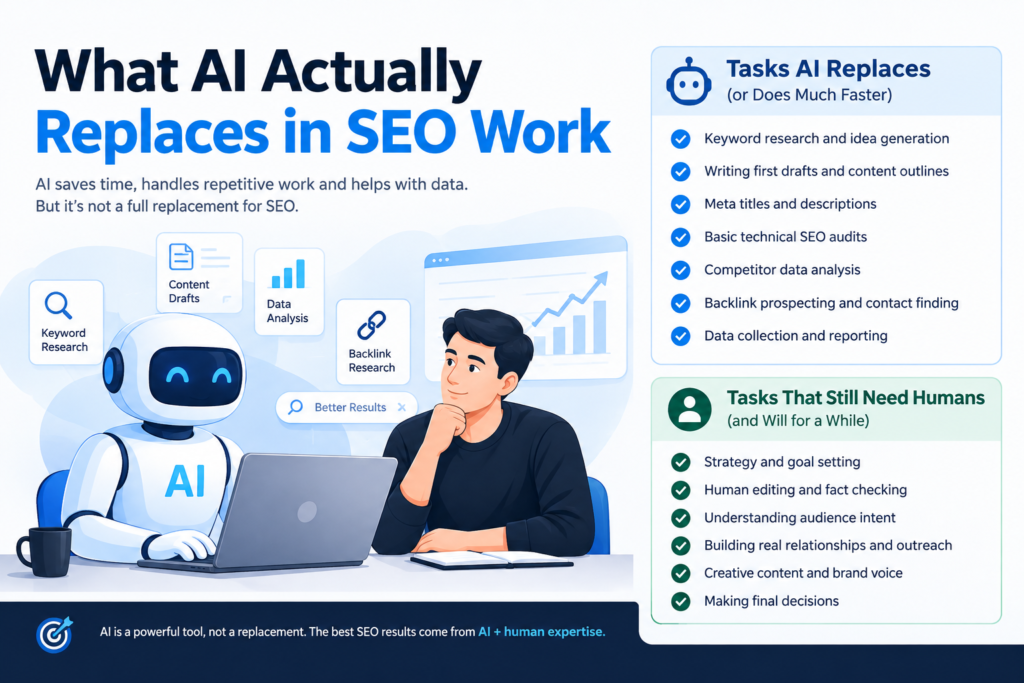
The mechanical, repeatable parts of the job are genuinely faster with AI. The parts requiring judgment about your specific business, customers, and risk tolerance aren’t going anywhere.
| SEO task | Where AI genuinely helps | Where a human still has to own it |
|---|---|---|
| Keyword & topic research | Clustering queries, surfacing patterns across thousands of terms in minutes | Judging which topics actually connect to revenue, not just volume |
| Content briefs & outlines | Drafting structure, pulling likely subtopics and questions | Deciding what makes this piece different from the ten others already ranking |
| First drafts | Producing a workable starting point fast | Fact-checking, adding real expertise, cutting the generic filler |
| Technical audits | Flagging errors, explaining likely causes at scale | Reproducing the bug, understanding why it’s happening, verifying the fix actually worked |
| Internal linking | Suggesting related pages based on content similarity | Confirming the link genuinely helps a reader, not just an algorithm |
| Reporting & analysis | Summarizing trends across dashboards | Connecting the numbers to a business decision worth making |
The pattern holds across every row: AI is fast at pattern-matching and production. It has no reliable way to know which product line is actually profitable for you, whether a technical fix will hold up under load, whether a health or financial claim is safe to publish, or whether a page is genuinely more useful than what’s already ranking. Those are judgment calls tied to context AI doesn’t have — which is exactly why “AI replaces tasks, not accountability” is a more accurate framing than “AI replaces SEO.”
What’s Becoming More Valuable, Not Less
If AI is absorbing the mechanical work, the market should be paying a premium for the human judgment that’s left. It is, and there’s a paper trail.
Search Engine Journal’s April 2026 analysis of 946 full-time SEO job postings from December 2025 through March 2026 found that roles mentioning AI in the job title carried a median salary of $113,625, versus $89,438 for otherwise-similar listings that didn’t — a 27% gap. Even when “AI” only showed up in the job description rather than the title, salaries ran about 25% higher. Separately, workforce-analytics firm Lightcast studied over 1.3 billion job postings across industries and found AI-related skills commanded roughly a 28% salary premium, or about $18,000 a year more, on average.
The signal from the labor market is consistent: employers are actively paying more for people who can combine SEO judgment with AI fluency, not replacing that judgment with software.
The same logic shows up in what actually earns visibility once AI is doing the summarizing. Seer Interactive’s tracked dataset found that brands cited inside an AI Overview saw 35% more organic clicks and 91% more paid clicks than when they weren’t cited at all — meaning the fight isn’t over whether AI Overviews exist, it’s over whether you’re one of the sources they pull from. And Google doesn’t have a private algorithm for that either; it pulls from the same pool of indexed, well-structured, genuinely useful pages it always has.
What actually earns a citation, based on what both Google’s guidance and the competitive landscape consistently reward, is content that can’t be produced by asking a chatbot the same question ten different ways:
- Original data — surveys, tests, internal benchmarks, before/after results
- Direct experience — screenshots, demonstrations, “here’s what actually happened when we tried this”
- Named expertise — a real person’s name, credentials, and track record attached to the claim
- Local or industry-specific detail a generic answer would never include
- Honest limitations — what didn’t work, what the trade-offs actually are
An article about, say, “best CRM for a 10-person sales team” that just defines CRM features is invisible next to one that names specific tools the writer has actually deployed, includes real pricing after negotiation, and says plainly which one they’d avoid and why.
Meet GEO — SEO’s New Sibling, Not Its Replacement
You’ll increasingly see the term GEO (Generative Engine Optimization), sometimes called AEO (Answer Engine Optimization), used alongside SEO and LLM SEO. It’s not a rebrand and it’s not a replacement — it’s the practice of increasing the odds that ChatGPT, Perplexity, Gemini, or Google’s AI features cite and describe your brand accurately when someone asks a related question, even if that never results in a click.
The overlap with traditional SEO is large: clear structure, direct answers near the top of a page, accurate and current information, strong entity signals (who you are, what you do, why you’re credible), and content that’s easy to parse are good for GEO and good for classic rankings. The difference is mainly in measurement and intent — GEO cares about being mentioned and cited even without a click, while SEO has traditionally measured success by the click itself.
In practice, a serious content strategy now has to track both: rankings and traffic on one side, brand mentions and citation frequency inside AI answers on the other. Tools built for this are still maturing — options like Semrush’s AI Visibility toolkit, Ahrefs’ Brand Radar, or newer standalone platforms are worth evaluating, though none of them have “solved” AI-citation tracking the way rank trackers solved SERP tracking two decades ago.
The Biggest Mistake: Fighting AI Overviews With More AI Content
The instinctive response to falling organic traffic is to publish more. That instinct is exactly backwards right now, and it’s the mistake most likely to get a site penalized rather than rescued.
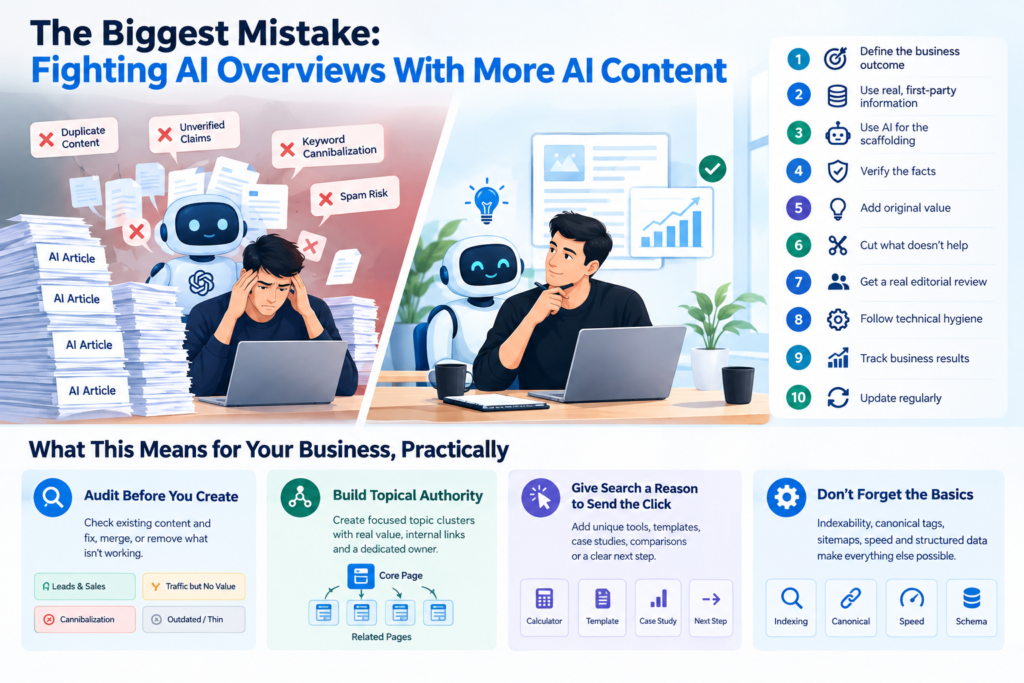
Mass-producing AI-written pages to chase every long-tail variation of a keyword tends to create duplicate or near-duplicate content, unverified claims, pages that cannibalize each other in the rankings, and — per Google’s own spam policy language cited above — a real risk of manual or algorithmic action for scaled content abuse.
It also just doesn’t work on the merits: if a page reads like something anyone could generate in thirty seconds, it gives an AI Overview nothing to cite that it couldn’t already produce itself, and it gives a human reader no reason to stick around.
A workflow that actually holds up looks more like this:
- Start with the business outcome, not the keyword — who’s the customer, what decision are they trying to make, what does this page need to move that decision forward.
- Gather real, first-party information before writing anything — data, examples, quotes from someone who’s actually done the thing.
- Use AI for the scaffolding: clustering related queries, drafting an outline, spotting gaps against competitors, producing a rough first pass.
- Verify every factual claim a human would stake their name on, especially anything touching health, money, law, or safety.
- Add what AI can’t invent — original data, direct experience, a genuine point of view.
- Cut what doesn’t serve a distinct need, rather than defaulting to “publish more.”
- Route it through a real editorial review, not just a spell-check.
- Publish through normal technical hygiene — proper indexing, canonical tags, internal links that make sense for a reader.
- Track leads, calls, and revenue influenced, not just impressions.
- Update it when the facts, the product, or the competitive landscape change — a page written once and never touched again ages out of relevance fast in a market moving this quickly.
What This Means for Your Business, Practically
Audit before you produce anything new. Sort existing content into four buckets: pages already generating leads or sales, pages with traffic but no business value, pages competing against each other for the same intent, and pages that are outdated or too thin to matter. Fix, merge, or remove before adding more volume.
Pick your battles on topical authority. Rather than a page for every keyword variation, build a small cluster around each topic you genuinely have credibility in: one strong core page, a handful of pages answering real distinct questions around it, internal links that follow how a reader would actually move through the decision, and a named person or team responsible for keeping it current.
Give AI Overviews and search results a reason to send the click anyway. A page that just repeats what’s already summarized has nothing to offer once the AI answer exists. A page with a calculator, a downloadable template, a deeper case study, a comparison built from real testing, or a clear next step gives someone a reason to keep going past the summary.
Don’t neglect the unglamorous technical work. Indexability, clean canonical tags, working sitemaps, mobile performance, page speed, and structured data don’t directly “optimize for AI” — but per Google’s own documentation, none of the AI-era visibility is possible without them. This is the foundation everything else sits on, and it’s the part most likely to get skipped when a team is chasing the newer, shinier GEO tactics instead.
How to Measure Success When Rankings Alone Don’t Tell the Story
A page ranking #1 no longer guarantees it captures the majority of available clicks — the AI Overview above it might be answering the question before anyone scrolls down. That means the old scoreboard needs new entries alongside it:
- Brand mentions and citation frequency inside AI-generated answers
- Organic impressions and click-through rate specifically on queries where an AI Overview is present, tracked separately from queries where it isn’t
- Qualified leads and conversion rate from organic visitors, not just session count
- Branded search volume growth, a decent proxy for whether AI-mediated exposure is building real awareness even without a click
- Phone calls, form fills, and direction requests attributable to organic discovery
- Revenue reasonably influenced by organic content, even on an assisted-conversion basis
The underlying question worth asking about any piece of content isn’t “does this rank,” it’s does this create trusted attention that leads to a profitable action — because increasingly, ranking and getting the click are two different problems with two different solutions.
Frequently Asked Questions
Is SEO dead in 2026?
No. Search volume hasn’t collapsed — if anything, people are searching more, including inside AI chat interfaces. What’s changed is that a rising share of searches get answered without a click to any website, which makes the SEO that remains more competitive and more dependent on genuine authority rather than volume.
Will AI replace SEO jobs in the future?
It’s already reshaping which SEO jobs exist rather than eliminating the field outright. Purely execution-focused roles — manual keyword lists, templated content production, basic reporting — are shrinking fastest.
A survey of 80+ SEO professionals found content-writing roles seen as most exposed (29.9%), while technical SEO and strategy roles were seen as far less at risk (under 7% each), and the largest group of respondents (43.7%) didn’t expect AI to fully replace anyone. Strategic and technical roles are also commanding a documented salary premium, per the Search Engine Journal and Lightcast data above — the job is consolidating around judgment, not disappearing.
What’s the difference between SEO and GEO?
SEO optimizes for ranking in traditional search results and earning a click. GEO (Generative Engine Optimization) optimizes for being accurately cited or mentioned inside AI-generated answers, whether or not that produces a click. The technical and content foundations overlap heavily; the measurement doesn’t.
How do I get cited by ChatGPT, Perplexity, or Google’s AI Overviews? Start with the same fundamentals that earn organic rankings — indexable, well-structured, genuinely useful content — since none of these systems have a separate ranking mechanism that bypasses them. From there, original data, clear direct answers near the top of the page, named expertise, and up-to-date information are what consistently get pulled into AI-generated summaries.
Should I stop investing in blog content?
Stop investing in generic, interchangeable blog content. Original research, real product comparisons, first-hand case studies, and content built around genuine expertise are becoming more valuable as the generic version of everything becomes instantly and freely generatable by anyone’s chatbot.
The Bottom Line
AI isn’t going to make SEO irrelevant. It’s going to make shallow SEO — the kind built on volume, keyword-stuffed pages, and content nobody would miss if it disappeared — considerably less valuable, faster than most businesses are prepared for. The winners over the next few years won’t be the ones publishing the most content or chasing the newest GEO trick.
They’ll be the ones combining solid technical foundations, real first-hand expertise, original evidence competitors can’t copy, and visibility measured across every place customers actually ask questions now — not just the ten blue links.
That’s a harder standard than “write 500 words and hit publish.” It’s also exactly why the businesses that meet it are going to have a lot less competition than they expect.
Author:
M Usman Anwar is an SEO and Digital Marketing Specialist specializing in SEO, LLM SEO, Generative Engine Optimization (GEO), and Answer Engine Optimization (AEO). He helps businesses improve their online visibility across traditional and AI-driven search platforms, including Google, ChatGPT, Gemini, Claude, and Perplexity. His work combines technical SEO, content strategy, link building, and AI search optimization to help brands build stronger visibility, authority, and organic growth.